It's one of the first questions business owners ask when they begin thinking about retirement, succession planning, a partner buyout, or selling their business.
Unfortunately, it's also one of the most difficult questions to answer.
Most owners have an idea in their mind of what their business is worth long before they ever speak with a broker or valuation professional. Sometimes they're right. Often they're not. The challenge is that business value is not determined by the years of effort, sacrifice, risk, and long hours that went into building the company. It is ultimately determined by what a qualified buyer is willing to pay.
One of our favorite parts of the business brokerage process is performing a business valuation. Every company is different. Every industry is different. Every buyer views risk differently. Reaching a supportable opinion of value requires analyzing financial performance, identifying value drivers, evaluating risk factors, and comparing the business to similar companies that have sold in the marketplace.
It is equal parts art and science.
The goal is not to determine what the business should be worth in a perfect world. The goal is to determine its Most Probable Selling Price, or MPSP. In other words, what is the most likely range that a qualified buyer would be willing to pay under current market conditions?
That distinction is important because there is often a significant difference between what an owner hopes their business is worth and what the market is willing to pay.
A well-supported valuation helps bridge that gap by replacing assumptions with data, experience, and market reality.

Enter our confidential portal for a complimentary valuation. Depending on the nature of your business, it may be necessary for us to contact you for additional information.
If you are considering an exit, you may also find our guide to Selling a Georgia Business helpful https://springfieldstrategies.com/sell-a-georgia-business
The term "business valuation" is often used to describe several different types of analyses, which can create confusion for business owners.
A formal business appraisal is typically performed by a CPA or accredited valuation professional and is often used for tax matters, litigation, estate planning, shareholder disputes, or other legal purposes. These reports can be highly detailed and may cost thousands of dollars.
There are also valuations prepared for lending, insurance, and other specialized purposes. While these analyses may determine a value for the business, they are not necessarily designed to predict what a buyer would pay in an open market transaction.
For owners considering the sale of their business, the most important question is usually much simpler:
What is my business likely to sell for?
That is where a Most Probable Selling Price (MPSP) analysis becomes valuable.
Rather than focusing on theoretical value, an MPSP analysis attempts to determine the most likely range a qualified buyer would be willing to pay under current market conditions. This involves reviewing financial performance, evaluating risk factors, identifying value drivers, and comparing the business to similar companies that have sold in the marketplace.
While no valuation can guarantee a future selling price, a well-supported opinion of value provides a realistic starting point for planning an exit strategy, evaluating offers, and making informed decisions about the future of the business.
Perhaps most importantly, it helps business owners separate what they hope the business is worth from what the market is likely willing to pay.
One of the most common misconceptions among business owners is that there is a universal formula for determining business value. In reality, different businesses are valued differently depending on their size, industry, risk profile, growth prospects, and buyer pool.
For most Main Street businesses, value is primarily driven by cash flow.
Buyers are not purchasing your business based solely on revenue. They are purchasing the future economic benefit they expect to receive from owning it. As a result, earnings are often the starting point for determining value.
For owner-operated businesses, valuation is frequently based on Seller's Discretionary Earnings (SDE). SDE represents the total financial benefit available to a full-time owner and typically includes the owner's compensation, certain discretionary expenses, and other adjustments that may not continue under new ownership.
As businesses grow, the valuation approach often changes. Lower-middle-market companies are more commonly valued using EBITDA (Earnings Before Interest, Taxes, Depreciation, and Amortization). These businesses are frequently purchased by larger strategic buyers, investors, or private equity groups who evaluate opportunities differently than individual owner-operators.
In addition to earnings, a valuation professional may consider other factors such as:
Comparable sales data also plays an important role. By reviewing actual transactions involving similar businesses, it is possible to develop a better understanding of what buyers have historically been willing to pay for businesses with similar characteristics.
The goal is not to force every business into the same formula. The goal is to evaluate the unique strengths, weaknesses, opportunities, and risks of a specific company and determine a supportable range of value based on current market conditions.
Business owners and buyers often look at the same company very differently.
Owners see years of hard work, sacrifice, opportunity, and future potential. Buyers tend to focus on one thing above all else: risk.
A valuation is ultimately an exercise in understanding how buyers perceive risk and how that perception affects the price they are willing to pay.
For example, an owner may see a temporary decline in revenue as a one-time event with a logical explanation. A buyer may see uncertainty. An owner may view a long-term employee's retirement as an opportunity to bring in new talent. A buyer may see the loss of a key contributor. An owner may have exciting plans for a new product or service line. A buyer may see an unproven concept that has yet to generate revenue.
Neither perspective is necessarily wrong. The market simply tends to reward businesses that demonstrate stability, predictability, and reduced risk.
Some of the factors that can positively influence value include:
Factors that can negatively impact value may include:
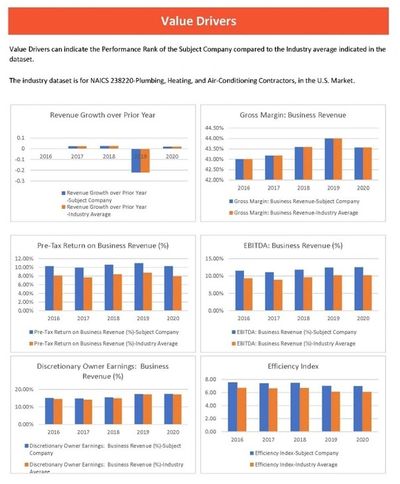
One of the most important aspects of the valuation process is identifying these drivers and understanding how they compare to similar businesses that have successfully sold.
While financial performance is often the foundation of a valuation, the factors above frequently determine whether a business sells at the upper end or lower end of a valuation range. Two companies with identical earnings can have dramatically different values if buyers perceive one as significantly riskier than the other.
Understanding these value drivers can also help business owners improve the marketability of their company long before they decide to sell.
Reasonable professionals can review the same business and arrive at slightly different conclusions. However, that does not mean every opinion of value is equally supported.
Business owners should be cautious of valuation opinions that consist of a single number with little or no explanation of how that conclusion was reached.
If someone tells you your business is worth $1,000,000, the next question should be simple:
Why?
What financial information was reviewed?
What adjustments were made to the earnings?
What comparable transactions were considered?
What risks were identified?
What value drivers were recognized?
How does the business compare to others that have recently sold?
A supportable valuation should answer those questions.
Unfortunately, not all valuation opinions are created equal. Some advisors rely heavily on industry rules of thumb. Others may apply a generic multiple without fully understanding the unique characteristics of the business. In some cases, an overly optimistic value may be presented simply to secure a listing engagement.
The reality is that determining a Most Probable Selling Price requires much more than applying a multiple to a financial statement.
A quality valuation should include a review of the company's financial performance, an analysis of risk factors, an evaluation of value drivers, and a comparison to relevant market data. More importantly, it should explain how those factors influenced the final opinion of value.
Business owners do not need a 100-page report filled with technical jargon. They do deserve a valuation that provides a clear explanation of how the conclusion was reached.
At Springfield Strategies, our goal is not to tell clients what they want to hear. Our goal is to provide a realistic, supportable opinion of value that helps owners make informed decisions about the future of their business.
After all, the purpose of a valuation is not to determine the highest possible number. The purpose is to determine the most probable outcome in the marketplace.
Not all businesses are valued the same way because not all buyers are looking for the same thing.
For many Main Street businesses, the most likely buyer is an individual seeking business ownership, a career change, or an opportunity to control their own future. These buyers are often focused on Seller's Discretionary Earnings (SDE), financing availability, and the income the business can provide to them as an owner-operator.
As businesses grow, the buyer pool often changes.
Companies generating more than $1 million in EBITDA frequently attract interest from private equity groups, family offices, strategic acquirers, and other professional investors. These buyers typically evaluate opportunities differently than individual purchasers. Rather than buying a job, they are making an investment.
As a result, valuation methods, transaction structures, and marketing strategies often evolve as businesses move into the lower middle market.
In some situations, an advisor may recommend marketing a lower middle market business without a published asking price. This approach allows qualified buyers to evaluate the opportunity and submit indications of interest based on their own investment criteria. When multiple buyers compete for an acquisition, sellers may benefit from increased leverage, stronger deal terms, higher cash-at-closing offers, or the opportunity to retain equity in the future growth of the company.
Understanding the likely buyer pool is an important part of any valuation. A business is not worth the same amount to every buyer, and identifying the right audience is often just as important as determining the right price.
Please reach us at chris.springfield@springfieldstrategies.com if you cannot find an answer to your question.
The value of a business depends on a variety of factors, including earnings, growth trends, industry conditions, customer concentration, management structure, lease terms, and overall risk. While online calculators may provide rough estimates, a professional valuation considers the unique characteristics of the business and current market conditions.
A business appraisal is typically a more formal analysis prepared by an accredited valuation professional for tax, legal, or other specialized purposes. A business valuation for sale purposes is generally focused on determining a Most Probable Selling Price (MPSP), or what a qualified buyer is likely willing to pay in the current market.
The timeline depends on the complexity of the business and the availability of financial information. Most valuations can be completed within a matter of days once the necessary documents have been provided.
At a minimum, most valuations require financial statements, tax returns, information about owner compensation, lease details, and a general understanding of the business operations. Additional information may be requested depending on the size and complexity of the company.
Most small businesses are valued primarily based on cash flow. Valuation methods often consider Seller's Discretionary Earnings (SDE), EBITDA, asset values, market transaction data, and various risk factors that may affect buyer demand.
Absolutely. Many owners obtain a valuation years before they intend to sell. Understanding the factors that drive value can help identify opportunities to improve profitability, reduce risk, increase marketability, and ultimately maximize proceeds when the business is brought to market.
No. A valuation is an informed opinion based on available information and market conditions at a specific point in time. The actual selling price will ultimately be determined by buyer demand, deal structure, financing availability, negotiations, and other market factors.
Springfield Strategies specializes in helping business owners understand value from the perspective that matters most: the marketplace. Our valuation process combines financial analysis, transaction data, industry knowledge, and real-world buyer behavior to develop a supportable opinion of value and Most Probable Selling Price. More importantly, we explain how that conclusion was reached so owners can make informed decisions with confidence.
A business valuation is more than a number. It is a tool that helps business owners understand their options, plan for the future, and make informed decisions about an eventual exit.
Whether you are considering selling your business, planning for retirement, evaluating a partner buyout, or simply curious about your company's current market value, a professional opinion of value can provide clarity and direction.
Springfield Strategies provides confidential business valuation services for owners throughout Metro Atlanta and Georgia. Our valuation process combines financial analysis, market data, transaction experience, and real-world buyer behavior to develop a supportable opinion of value and Most Probable Selling Price.
Are you ready for an exit? Download our free guide to learn the critical factors involved.
Exit Planning Guide (pdf)
DownloadWe believe fair, transparent, and ethical representation for all clients is the number one priority.
We are reliable and accountable, and always follow through on our commitments.
We strive to have the knowledge and expertise to provide our clients with the highest level of service.
We believe accepting responsibility for our actions (and inactions) is the ultimate way to build trust internally and externally.
We respect the sensitivity of the information we handle and maintain strict confidentiality.
We are committed to working with our clients, colleagues, and partners to achieve our client’s goals and deliver a great experience for all stakeholders.

Click below to visit our confidential valuation portal
We use cookies to analyze website traffic and optimize your website experience. By accepting our use of cookies, your data will be aggregated with all other user data.